Chase Sapphire Preferred Hyatt 4:3: Transfer, Upgrade, or Wait? (2026)
Chase Sapphire Preferred moves to a 4:3 Hyatt transfer ratio on October 1, 2026 (existing holders) — meaning 40,000 UR becomes 30,000 Hyatt points instead of 40,000. Chase Sapphire Reserve is unaffected and keeps 1:1 permanently. Transfer before October 1 only if you have a specific booking ready; otherwise keep UR flexible or consider upgrading to CSR.
On this page▾

Topic Collection
Part of the Transfer Partners Collection
Explore all 71 articles
Last updated: June 2026.
⚠️ Breaking change: Chase has confirmed that Sapphire Preferred and Ink Preferred cardholders will move from a 1:1 World of Hyatt transfer ratio to 4:3 on October 1, 2026. New CSP applicants from June 15, 2026 are already on the 4:3 rate. Sapphire Reserve is not affected and retains 1:1 permanently. This guide is your decision-tree for what to do about it. — Source: Chase press release
If you have a Chase Sapphire Preferred and a World of Hyatt account, the clock is ticking. Starting October 1, 2026, every 4 Ultimate Rewards points you transfer to Hyatt will become only 3 Hyatt points — not 4.
That's a 25% reduction in transfer value. For heavy Hyatt users, it's meaningful. For occasional users, it might not change anything.
This guide helps you figure out exactly which camp you're in, and what to do about it.
What the 4:3 ratio actually means (the math)
"4:3 ratio" sounds abstract. Here's what it means in dollars and cents.
| Scenario | UR Needed | Hyatt Points Received | Effective CPP |
|---|---|---|---|
| Pre-Oct-1 CSP — 1:1 ratio | 100,000 | 100,000 | ~2.5¢/pt |
| Post-Oct-1 CSP — 4:3 ratio | 133,333 | 100,000 | ~1.875¢/pt |
| CSR — 1:1 always | 100,000 | 100,000 | ~2.5¢/pt |
In plain English: after October 1, you need 33% more UR points to get the same Hyatt points. A Category 4 hotel that costs 20,000 Hyatt points per night will require 26,667 UR instead of 20,000.
That's the cost of staying on the CSP versus upgrading to the CSR.
💡 The 4:3 ratio only applies to the transfer step. Hyatt's award chart is unchanged. A Category 4 property still costs 20,000 Hyatt points. The ratio just determines how many UR it takes to get those 20,000 Hyatt points.
Key takeaway: the 4:3 ratio is a 25% effective devaluation of every Chase point you plan to use at Hyatt — but only if you use CSP or Ink Business Preferred to transfer. CSR holders are completely unaffected.
Since both affected cards now sit at 4:3, the choice between them comes down to earn structure and fee — our Chase Ink Business Preferred vs Chase Sapphire Preferred comparison lays that out for anyone deciding which to keep as their transfer card.
The decision tree: 4 options
You have four paths forward. Here's the honest analysis of each.
Option A — Transfer before October 1 (only if you have a specific booking)
Who this is for: CSP holders who already have a Hyatt stay planned in the next 12–24 months and know exactly which property and dates they want.
Who this is NOT for: anyone thinking "I'll transfer points now and figure out the trip later." That is speculative transfer and it is almost always a mistake.
The rule is the same it's always been: never transfer Chase points to Hyatt speculatively. Hyatt points expire after 24 months of account inactivity. You'll lock in points in a less-flexible currency that can only be used at Hyatt properties.
How to execute Option A strategically:
- Identify your specific Hyatt property and travel dates
- Verify award availability on world.hyatt.com before touching your Chase account
- Screenshot the available award rate so you can book immediately after transferring
- Calculate exactly how many UR you need: (Hyatt points needed) × 4/3 = UR post-October-1, or 1:1 = UR before October-1
- Transfer the exact amount. Not a round number — the exact amount.
- Book the award within minutes of the transfer completing
⚠️ Critical reminder: Hyatt transfers complete in 5–15 seconds. Award availability can disappear in that window. Screenshot everything before you transfer.
Key takeaway: transfer now only if you have a confirmed property, confirmed dates, confirmed award availability, and you're traveling within 12–24 months. Any one of those missing = don't transfer.
Option B — Do nothing and keep UR points
Who this is for: CSP holders who don't stay at Hyatt regularly, or whose future travel plans don't point clearly to Hyatt properties.
Chase Ultimate Rewards are extraordinarily flexible. You have 13 other Chase transfer partners that still operate at full 1:1 ratios, including:
- Air France/KLM Flying Blue — excellent Promo Award pricing to Europe
- Singapore Airlines KrisFlyer — Business Class to Asia and beyond
- United MileagePlus — Star Alliance partner redemptions
- British Airways Avios — short-haul American Airlines + Iberia premium
- Aer Lingus, Iberia, Virgin Atlantic — transatlantic premium cabins
- Southwest Rapid Rewards — domestic travel + Companion Pass
- IHG One Rewards, Marriott Bonvoy — hotel alternatives
💡 The flexibility argument: An Ultimate Rewards point in your Chase account is worth more than a Hyatt point sitting in a World of Hyatt account, because it can go to 14 different programs. Don't transfer into Hyatt unless the math clearly justifies it.
If you're a light Hyatt user — one or two stays per year — the 4:3 change costs you relatively little in absolute terms. You might decide the CSP's lower annual fee ($95 vs $795 for CSR) is still the better deal even at the degraded ratio.
Key takeaway: if Hyatt isn't a core part of your travel strategy, the 4:3 change is largely noise. Keep your UR flexible, use the 13 other 1:1 partners, and optimize for the travel you actually do.
Option C — Product-change to Chase Sapphire Reserve
Who this is for: CSP holders who stay at Hyatt 3+ nights per year and want to preserve the 1:1 ratio without applying for a new card.
The CSR retains 1:1 Hyatt transfers permanently. That's the product's explicit commitment in Chase's press release. No hedge, no ambiguity. If you're weighing this, see upgrade CSP to CSR or apply fresh for the full breakdown.
The math on upgrading:
| CSP | CSR | |
|---|---|---|
| Annual fee | $95 | $795 |
| Travel credit | None | $300 |
| Effective cost after $300 travel credit | $95 | $495 |
| Hyatt transfer ratio | 4:3 (post-Oct-1) | 1:1 always |
| Net cost difference | — | +$155/year |
So the CSR costs effectively $155/year more than the CSP after applying the $300 travel credit.
Break-even analysis:
If you transfer 62,000 UR to Hyatt in a year, the difference between 1:1 (CSR) and 4:3 (CSP) is 15,500 Hyatt points. At 2¢/pt, that's $310 of value — more than the $155 premium. The CSR pays for itself above roughly 40,000 UR transferred to Hyatt annually.
📌 Important restriction: You cannot product-change a Chase Sapphire Preferred to a Chase Sapphire Reserve until you've had the CSP for at least 12 months. Check your open date before planning this move.
How to product-change:
- Call the number on the back of your CSP and ask to upgrade to CSR
- Chase typically does a soft pull (not a hard inquiry)
- Your existing Ultimate Rewards balance carries over to the new card
- Your account age and relationship stay intact
Key takeaway: the CSR product-change is the right move if you're Hyatt-loyal and transfer 40,000+ UR per year to Hyatt. Below that threshold, the math gets close and the lower CSP fee may still win.
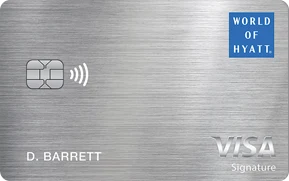
Option D — Apply for the World of Hyatt credit card
Who this is for: dedicated Hyatt loyalists who want to earn Hyatt points directly, without involving Chase UR transfers at all.
The World of Hyatt card earns Hyatt points directly from everyday spending — no transfer needed. Key benefits:
- Free night certificate annually (Category 1-4 property) just for having the card
- Additional free night after $15,000 in annual spend (Category 1-4)
- 5 qualifying night credits per year toward Globalist status
- Annual fee: $95
- Earning rate: 4x at Hyatt properties, 2x at fitness/gyms, 1x everywhere else
This card makes sense if:
- You stay at Hyatt 4+ times per year
- You want to decouple your Hyatt earning from Chase UR entirely
- You're working toward Globalist status and want the qualifying night credits
- You have a strong credit score and room under Chase 5/24
💡 The best scenario: Hold both the CSP/CSR and the World of Hyatt card. Earn Hyatt points directly from the cobrand, and use Chase UR transfers for large aspirational bookings where the math justifies it.
Key takeaway: the World of Hyatt card doesn't replace a Chase UR strategy — it complements it. For Hyatt loyalists, it's the highest-leverage card you can add to your wallet for $95/year.
Deep dive: should you transfer before October 1?
Let's be precise about when a pre-October-1 transfer is rational.
Transfer now if all of the following are true:
- ✓ You have a Hyatt property and specific travel dates identified
- ✓ Award availability is showing on world.hyatt.com for those dates today
- ✓ You're traveling within 12–18 months (to avoid inactivity-driven point expiration)
- ✓ The redemption clears at least 1.875¢/pt on the post-Oct-1 4:3 math (or ideally 2.0¢/pt+)
- ✓ You won't need those UR for a potentially higher-value airline or other hotel transfer
Do not transfer if:
- ✗ You don't have a specific trip in mind ("locking in the 1:1 rate" on unplanned points is speculative)
- ✗ Award availability isn't showing — you'll transfer points that sit idle in Hyatt
- ✗ You think you might use the UR for airline miles instead — those are still at 1:1 forever
- ✗ The property you want is in a high category and the effective CPP is below 1.5¢/pt
The speculative transfer trap
Here's the scenario that ends badly: you transfer 80,000 UR to Hyatt in August 2026, "just to lock in the 1:1 ratio." Then life changes. You can't take the trip. 18 months later, no Hyatt activity. Your 80,000 Hyatt points expire.
You've lost 80,000 points entirely because you tried to be clever.
The 1:1 window closing is a real deadline. But responding to a deadline with a bad decision is worse than accepting the new 4:3 rate.
⚠️ Hyatt point expiration: Hyatt points expire after 24 months of account inactivity. Any qualifying earn or redeem activity resets the clock. If you transfer now and don't use them, you must stay active on Hyatt or they disappear.
When to keep UR instead
Ultimate Rewards sitting in a Chase account are one of the most valuable currencies in the points universe. They don't expire as long as you keep at least one eligible UR-earning card open.
Here's when keeping UR beats transferring to Hyatt (even pre-October-1):
- You're planning a flight redemption — airline partners are all still at 1:1
- You're targeting a non-Hyatt hotel — IHG and Marriott are 1:1 (though usually worse value)
- You might upgrade to CSR later — then you'll still get 1:1 on future transfers
- You want maximum flexibility — a UR point can go to 14 programs; a Hyatt point can only go to Hyatt
- You're traveling beyond 18 months from now — speculative long-horizon transfers carry expiration risk
When 4:3 still beats the Chase Travel portal
Even at the degraded 4:3 ratio, transferring to Hyatt frequently beats redeeming UR through the Chase Travel portal — where redemptions without a Points Boost offer are worth just 1.0¢ per point (CSP Boost offers cap at "up to 1.5¢"). This is especially true on the best Hyatt sweet spots under 15k points, using the May 20, 2026 five-tier chart at the Lowest (Saver) tier:
| Hyatt cat (Lowest tier) | Hyatt pts | UR at 4:3 | ~Cash rate | ¢/UR at 4:3 | Beats 1.0–1.5¢ portal? |
|---|---|---|---|---|---|
| Cat 1 | 3,000 | 4,000 | ~$150 | ~3.7¢ | Yes |
| Cat 4 | 12,000 | 16,000 | ~$420 | ~2.6¢ | Yes |
| Cat 6 | 20,000 | 26,667 | ~$550 | ~2.1¢ | Yes |
| Cat 7 | 25,000 | 33,334 | ~$725 | ~2.2¢ | Yes |
Should you upgrade to Chase Sapphire Reserve?
The product-change question deserves its own careful analysis because it's the most financially significant decision in this guide.
Arguments for upgrading to CSR:
- Locks in 1:1 Hyatt ratio permanently — no future risk of further devaluations
- Better travel insurance (higher trip delay limits, primary car rental coverage)
- Priority Pass Select lounge access for you + guests
- Points Boost portal offers up to 2.0¢/pt on CSR (vs up to 1.5¢ on CSP; both default to 1.0¢ without a Boost)
- $300 travel credit that most frequent travelers use fully
Arguments against upgrading:
- $155/year effective premium is real money
- If you don't hit the 40,000 UR/Hyatt transfer break-even, the upgrade doesn't pay off
- CSR's $795 fee can be psychologically difficult vs CSP's $95
- You must have held the CSP for 12 months first
By traveler profile:
| Profile | Recommendation |
|---|---|
| Casual CSP holder, stays at Hyatt 0-1x/year | Stay on CSP. 4:3 costs you little in practice. |
| CSP holder, 2-3 Hyatt stays/year | Run the math. If you transfer 40K+ UR/year to Hyatt, upgrade pays. |
| Heavy Hyatt user, 4+ stays/year | Upgrade to CSR or get the World of Hyatt card or both. |
| Already on CSR | Nothing to do. You're set. |
| Business card user (Ink Business Preferred) | Consider pairing with a CSR for personal travel; Ink transfers go to 4:3 too. |
Bottom line: recommendations by traveler profile
"I have a specific Hyatt booking planned before October 1 — should I transfer now?"
Yes, with discipline. Confirm award availability first, transfer only what you need, and book immediately after.
"I have Chase points but no specific Hyatt trip planned — what should I do?"
Nothing. Keep your UR flexible. The 13 other 1:1 partners give you plenty of options. Don't create a problem by reacting to a deadline.
"I stay at Hyatt regularly and use my CSP for most of my Hyatt transfers — what now?"
Call Chase and product-change to CSR if you've had the CSP 12+ months. The 1:1 ratio lock-in is worth the $155/year premium at your usage level.
"I love Hyatt but I'm not sure about the $795 CSR fee — is there a middle path?"
Yes: the World of Hyatt credit card at $95/year. It earns Hyatt points directly, gives you a free night cert annually, and progress toward Globalist. You don't have to pay CSR's annual fee to be Hyatt-loyal.
"I use the Ink Business Preferred for business spending — how does this affect me?"
Same as CSP holders: 4:3 ratio effective October 1, 2026. Consider adding a personal CSR if Hyatt is a meaningful part of your business travel strategy.
The 4:3 change is real and it matters for heavy Hyatt users. But it's not a crisis — it's a recalibration. Make the decision that matches your actual travel, not the one that feels most responsive to the deadline.
Related reading
- Chase → Hyatt 4:3 ratio deep-dive — the full news breakdown on the ratio change itself
- How to transfer Chase points to Hyatt — the step-by-step transfer guide
- Hyatt Award Chart 2026 — full category breakdown and sweet spots
- Upgrade CSP to CSR or Apply Fresh? — the complete upgrade analysis
- Chase Sapphire Trifecta 2026 — maximizing the full Chase ecosystem
- Trip Planner — free tool to model your next Hyatt redemption
Get weekly card offer alerts
Sunday digest of elevated bonuses. One email, zero spam.
Cards mentioned in this guide



Frequently asked questions
What does the Chase Sapphire Preferred 4:3 Hyatt change mean?
Should I transfer Chase points to Hyatt before October 1?
Is it worth upgrading to Chase Sapphire Reserve because of the 4:3 change?
Will Hyatt points expire if I transfer them now?
Does the 4:3 ratio affect Chase Sapphire Reserve?
How many Chase points do I need for a Hyatt Category 4 hotel now?
Should I get the World of Hyatt credit card instead of CSP?
Can I undo a Chase to Hyatt transfer?
Does the 4:3 change affect Chase Ink Business Preferred?
When exactly does the 4:3 ratio take effect?
Is the Chase–Hyatt 4:3 ratio permanent?
Does the Chase Sapphire Reserve get 4:3 too?
How do I calculate how many UR I need at 4:3?
References
Primary sources and further reading cited in this guide.
- Chase Press Release: Meet the New Chase Sapphire PreferredOfficial
- The Points Guy: Chase Sapphire Preferred Hyatt Transfer Ratio ChangeMedia
- One Mile at a Time (OMAAT): Chase Changes Hyatt Transfer RatioMedia
- FrequentMiler: Chase Sapphire Preferred 4:3 Hyatt Transfer AnalysisMedia
- World of Hyatt Award Chart (verified June 2026)Hotel
Related guides
Rewards Programs
How to Transfer Chase Points to Hyatt (2026 Guide)
14 min
Strategy
Chase Sapphire Preferred Review 2026: Refreshed Benefits, New Hyatt Ratio, Still Worth $95?
12 min
Card Roundups
Best Credit Cards for Hyatt Stays in 2026
9 min
Rewards Programs
World of Hyatt: The Complete 2026 Program Guide
12 min
Related news

chase · Jun 10, 2026
Chase Hyatt Transfer Ratio 4:3: What It Means for Sapphire Preferred and Ink Business Preferred

hyatt · Jun 3, 2026
Hyatt Added Perk for Globalists, Explorists and Cardholders

hyatt · Jun 2, 2026
Hyatt’s Chart Change Just Repriced Your Chase Points

chase · Jun 10, 2026
Chase to Virgin Atlantic: 30% Transfer Bonus — Book Delta Business Class for 18,000 Points
Cards in this ecosystem




Considering switching?