Meeting an $8k+ Business Card Minimum Spend Without Wasting Money
Treat a large minimum spend as a timing problem. First count the three months of business charges you would make anyway, which typically covers 40 to 70 percent of the requirement. Then pull future spending forward for free by switching software to annual billing, prepaying insurance and buying planned equipment early. Only then close the remaining gap by paying a fee: federal tax through Pay1040 at 1.75 percent is the cheapest route, and vendor or rent payments through Plastiq at 2.99 percent work where the recipient does not take cards. Set a fee ceiling of roughly 15 percent of the bonus value before you start, and avoid manufactured spending and gift-card cycling, which breach issuer terms and risk account closure with the points forfeited.
On this page▾

Topic Collection
Part of the Business Credit Cards Collection
Explore all 42 articles
An $8,000 requirement is not a spending problem, it is a timing problem. Almost nobody needs to invent $8,000 of purchases; they need to move purchases they were already going to make into a single three-month window, and pay a small fee on whatever gap remains. Framed that way, the question becomes simple arithmetic: what is the most you should pay to unlock the bonus?
Quick answer
Start with spending you already have, pull future spending forward, and only then pay a fee to close the gap. Paying a fee is usually correct on a large bonus: a 2.99 percent fee on a $3,000 shortfall costs $90, which is trivial against a bonus worth many hundreds of dollars. The routes worth using, cheapest first, are federal tax at 1.75 percent through Pay1040, then vendor and rent payments at 2.99 percent through a service like Plastiq. What is not worth using is manufactured spending or gift-card cycling, which breaches issuer terms and risks having the account and the points closed.
- First: existing recurring charges and known upcoming purchases
- Second: prepay annual costs you would pay later anyway
- Third: federal tax at 1.75 percent
- Fourth: vendor or rent payments at 2.99 percent
- Never: manufactured spending or gift-card cycling
💡 Pro tip — Work out your fee budget before you start. If the bonus is worth $900 to you, spending $150 in fees to guarantee it is an excellent trade. Deciding that number in advance stops both mistakes: refusing a $60 fee and losing the bonus, and paying $400 in fees to earn it.
Step 1: count what you already spend
Before anything else, list three months of business charges you would make regardless. Most people find more than they expect.
| Category | Typical three-month total |
|---|---|
| Software and subscriptions | $300-$1,500 |
| Advertising and marketing | $0-$5,000 |
| Phone, internet and utilities | $300-$900 |
| Contractors and freelancers | Varies widely |
| Inventory or materials | Varies widely |
| Insurance premiums | $200-$2,000 |
| Travel and meals | $200-$3,000 |
Key takeaway: the requirement is usually 40 to 70 percent covered before you change a single behaviour, and knowing that number tells you how big the real gap is.
Step 2: pull future spending forward
This is the highest-value move and it costs nothing.
- Switch annual billing on. Software billed monthly is almost always cheaper annually, so you save money and clear spend at once.
- Prepay insurance premiums where the carrier allows it.
- Buy planned equipment now rather than next quarter.
- Prepay advertising budgets on platforms that allow account credit.
- Settle outstanding invoices early where a vendor takes cards.
Three $600 annual renewals moved forward covers $1,800 without spending a dollar you would not have spent.
Step 3: buy the gap, cheaply
Only now does paying a fee make sense, and the order matters because the rates differ substantially.
| Route | Fee | Notes |
|---|---|---|
| Federal tax via Pay1040 | 1.75 percent | Cheapest; commercial cards are charged more |
| Federal tax via ACI Payments | 1.85 percent | Use when frequency limits block the cheaper one |
| Vendor and rent payments via Plastiq | 2.99 percent | Works where the recipient does not take cards |
| State and local tax | Varies | Some jurisdictions are cheaper than federal, some are not |
At 1.75 percent, closing a $4,000 gap costs $70. At 2.99 percent it costs $120. Both are small against a bonus worth several hundred dollars, which is why the fee is rarely the deciding factor once you have exhausted the free routes.
The fee budget
Set the ceiling before you start, based on what the bonus is actually worth to you.
| Bonus value to you | Sensible fee ceiling | Gap that buys at 2.99 percent |
|---|---|---|
| $400 | $60 | About $2,000 |
| $900 | $150 | About $5,000 |
| $1,500 | $250 | About $8,300 |
The rule of thumb is roughly 15 percent of the bonus value. Above that, the return gets thin; below it, you risk losing the whole bonus to save a small fee.
What not to do
Manufactured spending and gift-card cycling. Buying gift cards or cash equivalents to run up spend breaches issuer terms at every major bank. The realistic downside is not a declined transaction, it is account closure with the points forfeited, and that outcome is well documented.
Buying things you do not need. A $2,000 purchase you would not otherwise make costs $2,000, not the fee you avoided. This is the most common way people lose money while technically earning the bonus.
Overpaying a tax bill deliberately. Overpayment is refunded, but slowly, and the IRS frequency limits constrain how you can structure it.
Leaving it to the last week. Charges post on their own schedule, and a payment made on day 89 may post on day 92.
Timing details that matter
- The window usually starts at account opening, not at approval or at first use.
- The posting date counts, not the transaction date. Leave at least a week of margin.
- Refunds reduce your progress. A returned purchase subtracts from the tracked total.
- Annual fees usually do not count toward the requirement.
- Employee card spend usually does count, which is a genuine advantage of business cards over personal ones.
A worked example
An $8,000 requirement, three months, and a bonus you value at $900.
| Source | Amount | Cost |
|---|---|---|
| Existing business charges | $4,200 | $0 |
| Three annual renewals pulled forward | $1,800 | $0 |
| Federal estimated tax via Pay1040 | $2,000 | $35 |
| Total | $8,000 | $35 |
Thirty-five dollars to secure a $900 bonus. The lesson is not that the fee route is clever, it is that the free routes covered three quarters of the requirement before any fee was paid.
Common mistakes
- Starting with the fee route. Count your existing spend first; it is usually most of the requirement.
- Not setting a fee ceiling. Without one, people either refuse trivial fees or pay absurd ones.
- Using the more expensive tax processor. The gap is real money on a large payment.
- Manufactured spending. Account closure and forfeited points is the realistic risk.
- Missing the posting-date margin. The last week is not safe.
- Forgetting employee cards. Their spend usually counts toward the same requirement.
Editor's take
Large business minimum spends look intimidating and mostly are not, because the number that matters is the gap rather than the total. In our own testing the free steps, counting existing charges and pulling annual renewals forward, routinely cover two thirds to three quarters of an $8,000 requirement. That leaves a gap small enough that a 1.75 percent tax payment closes it for the price of a restaurant meal. If the gap is still large after those steps, the honest answer is that the card is too big for your business right now.
Related reading
- Why business card welcome bonuses are bigger — why the requirement is large in the first place
- Paying taxes with a credit card — the 1.75 percent route in full
- Paying rent and vendors by card — the 2.99 percent route in full
- Minimum spend strategy for a welcome bonus — the personal-card version
- Employee cards strategy — spend that counts without being yours
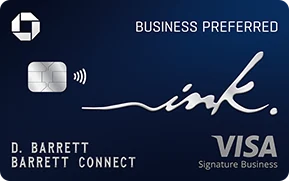
- Chase Ink business cards guide — the family these requirements usually attach to
Get weekly card offer alerts
Sunday digest of elevated bonuses. One email, zero spam.
Cards mentioned in this guide

Frequently asked questions
What is the cheapest way to hit a large minimum spend?
How much should I be willing to pay in fees to earn a bonus?
Does employee card spending count toward the minimum?
Is manufactured spending worth the risk?
When exactly does the spending window start and end?
Related guides
Strategy
Why Business Card Welcome Bonuses Are Bigger (and How to Qualify)
8 min
Strategy
Paying Taxes with a Credit Card: Processor Fees vs Rewards Math 2026
8 min
Strategy
Paying Rent and Vendors by Card: Bilt, Plastiq, and Alternatives 2026
8 min
Strategy
Minimum Spend Strategy: Hitting a Welcome Bonus Without Overspending
9 min
Related news

chase · Jun 10, 2026
Chase Hyatt Transfer Ratio 4:3: What It Means for Sapphire Preferred and Ink Business Preferred

chase · Jun 10, 2026
Chase to Virgin Atlantic: 30% Transfer Bonus — Book Delta Business Class for 18,000 Points

airlines · Jun 4, 2026
Alaska Atmos Members Day Launched

hyatt · Jun 3, 2026
Hyatt Added Perk for Globalists, Explorists and Cardholders