Chase Ink Business Cash vs Unlimited vs Preferred (2026)
Pick Ink Business Cash ($0 fee) if you spend heavily on office supplies, internet, cable or phone — it earns 5% on the first $25,000 per year. Pick Ink Business Unlimited ($0 fee) for a flat 1.5% on everything if your spend has no clear category winner. Pick Ink Business Preferred ($95 fee) for 3x on travel/shipping/advertising, travel protections, and the ability to make points transferable 1:1 to partners. Power users hold all three and pool points into Preferred, so the no-fee cards’ cash back becomes transferable Ultimate Rewards worth far more than 1 cent each.
On this page▾

Topic Collection
Part of the Business Credit Cards Collection
Explore all 37 articles
Three Chase Ink business cards, two of them with a $0 annual fee. The right answer is usually not "pick one" — it is which two or three you stack so your no-fee cash back becomes transferable Ultimate Rewards.
The Chase Ink trio is the most underrated points engine in the small-business space. Ink Cash earns 5% in office and telecom categories. Ink Unlimited earns a flat 1.5% on everything. Ink Preferred earns 3x on travel, shipping, internet/cable/phone and advertising, carries a $95 annual fee, and is the card that turns the whole stack into transferable points. Below is the per-business-type verdict, the math on the "Ink stacking" play, and exactly when the $95 fee pays for itself.
Quick answer
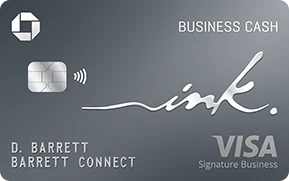
Get Ink Cash if your business spends heavily on office supplies, internet, cable or phone service. $0 annual fee, 5% back on those categories on the first $25,000 each calendar year, 2% at gas stations and restaurants on the first $25,000, and 1% on everything else. Maxing the 5% tier alone returns $1,250 per year.
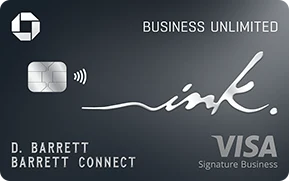
Get Ink Unlimited if your spend is spread across categories with no clear winner. $0 annual fee, a flat 1.5% on every purchase with no caps and no categories to track. It is the catch-all that beats the Cash card's 1% base rate everywhere outside the bonus categories.
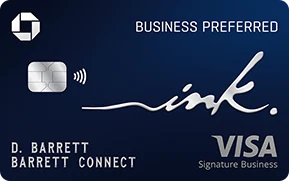
Get Ink Preferred if you want transferable points, travel protections, or you run real shipping and advertising spend. $95 annual fee, 3x on travel, shipping, internet/cable/phone and advertising (first $150,000 combined per year), no foreign transaction fee, and 1:1 transfers to Chase airline and hotel partners.
TL;DR: The three core Chase Ink business cards are Ink Business Cash ($0 annual fee; 5% on office supply stores and internet/cable/phone and 2% on gas and dining, each on the first $25,000 per year, 1% after), Ink Business Unlimited ($0 annual fee; flat 1.5% on everything), and Ink Business Preferred ($95 annual fee; 3x on travel, shipping, internet/cable/phone and advertising on the first $150,000 combined per year, plus strong travel protections and no foreign transaction fee). Cash and Unlimited earn Chase Ultimate Rewards that behave as cash back on their own, but become transferable to airline and hotel partners only when the cardholder also holds Ink Business Preferred (or a Chase Sapphire card) and pools points into that account. Power users hold all three: Cash for 5% categories, Unlimited for flat 1.5%, Preferred for travel categories and the transfer ability.
At a glance
| Ink Business Cash | Ink Business Unlimited | Ink Business Preferred | |
|---|---|---|---|
| Annual fee | $0 | $0 | $95 |
| Headline earn | 5% office + internet/cable/phone | flat 1.5% | 3x travel/shipping/ad/telecom |
| Bonus cap | $25,000/yr per 5% & 2% tier | none | $150,000/yr combined |
| Secondary earn | 2% gas + dining (first $25K) | — | — |
| Base rate | 1% | 1.5% | 1x |
| Points transferable alone? | No (cash back) | No (cash back) | Yes (1:1 to partners) |
| Foreign transaction fee | 3% | 3% | None |
| Travel protections | Basic | Basic | Strong (trip cancellation, primary auto) |
| Best for | Office/telecom-heavy spend | Flat catch-all | Travel + transfer engine |
The single most important row is "points transferable alone?" The Cash and Unlimited cards advertise cash back, but the rewards are denominated in Ultimate Rewards points. Held in isolation they redeem at 1 cent each. The moment you also hold Ink Preferred and move those points into its account, every point can transfer 1:1 to partners like United, Hyatt or Air France — frequently worth 1.5 to 2+ cents each.
How the no-fee cards become transferable
This is the mechanic most readers miss. Ink Cash and Ink Unlimited both earn full Ultimate Rewards points — they are not a separate, lesser currency. What they lack on their own is the transfer feature. Chase only lets points transfer to travel partners from an account that carries the annual-fee privilege: Ink Preferred, Ink Premier on the cash-back side, or a Sapphire Preferred / Sapphire Reserve on the personal side. If a no-fee Ink Cash plus one paid Sapphire is the whole setup you are considering, the Ink Business Cash vs Sapphire Preferred comparison shows how the two cards split the earning-versus-transfer roles.
So the play is: earn 5% with the Cash card and 1.5% with the Unlimited card at a $0 fee, then pool all of it into your Preferred account and transfer to partners. A business that puts $25,000 through the Cash card's 5% office/telecom tier earns 125,000 points. Cashed out, that is $1,250. Transferred to a partner at 1.8 cents per point, the same 125,000 points are worth roughly $2,250 — a 80% lift for the cost of one $95 annual fee.
The Ink stacking play
"Ink stacking" is holding all three cards and routing each purchase to the card that earns most:
- Office supply stores, internet, cable, phone → Ink Cash at 5%
- Travel, shipping, advertising → Ink Preferred at 3x
- Everything with no bonus category → Ink Unlimited at flat 1.5%
All points land in one transferable pool. The Cash card covers two of the highest-frequency small-business categories. The Preferred card covers the travel and operational categories and unlocks transfers. The Unlimited card mops up the long tail at 1.5% — 50% better than the Cash card's 1% base on non-bonus spend.
| Spend bucket | Best Ink card | Rate | On $10,000 |
|---|---|---|---|
| Office supplies + telecom | Ink Business Cash | 5% | 50,000 pts |
| Shipping + advertising | Ink Business Preferred | 3x | 30,000 pts |
| Travel (business) | Ink Business Preferred | 3x | 30,000 pts |
| Uncategorized spend | Ink Business Unlimited | 1.5% | 15,000 pts |
Because each Ink product is a separate application with its own welcome bonus, opening them in sequence (respecting Chase 5/24) also stacks sign-up bonuses — often 90,000 to 100,000+ points per card. A maximizer who opens all three over 18 months can bank 270,000+ points from welcome bonuses alone, on top of ongoing category earn. Pooled into the Preferred account and transferred at 1.8 cents, that welcome-bonus haul alone is worth roughly $4,860 of travel — many times the single $95 annual fee.
One ordering note: open the Preferred card at some point in the sequence even if its categories are not your heaviest, because it is the card that makes the entire pool transferable. Without it, the Cash and Unlimited welcome bonuses are stuck at 1 cent per point. Many cardholders open a $0-fee card first to start earning, then add Preferred once they hold a balance worth transferring.
Where each card quietly outearns the others
A few overlooked details decide real-world value. Ink Cash codes a surprising amount of software, web hosting, and cloud-subscription spend as "office supply" or "internet/cable/phone," so businesses that thought they had no 5% categories often max out one tier without trying. Ink Preferred is the only one of the three with no foreign transaction fee — a 3% saving on every international charge — plus trip-cancellation and primary auto-rental coverage that a separate purchase would cost real money to replicate. Ink Unlimited wins the boring-but-large bucket: its flat 1.5% beats the Cash card's 1% base on every dollar of uncategorized spend, which for many businesses is the single largest line item. On $40,000 of miscellaneous annual spend, that 0.5% gap is worth 20,000 extra points a year.
Verdict by business type
Solo consultant / freelancer with light, mixed spend
Start with Ink Unlimited. Flat 1.5%, no categories to manage, $0 fee. If you later want lounge-free travel value, add Ink Preferred to unlock transfers on the points you already banked.
Office-heavy business (supplies, software, phone/internet)
Lead with Ink Cash. The 5% on office supply stores and internet/cable/phone is the highest everyday business rate Chase offers, up to $25,000 per category tier. Many software and SaaS purchases route through office-supply merchant codes too. Pair with Preferred once your points pile is worth transferring.
Travel-, shipping-, or ad-heavy business
Ink Preferred is the anchor. 3x on travel, shipping and advertising on up to $150,000 combined per year, no foreign transaction fee, and the strongest travel protections in the Ink line (trip cancellation/interruption and primary auto rental coverage when you rent for business). An e-commerce seller or agency easily maxes the ad/shipping 3x.
Maximizer who wants every point transferable
Hold all three. Cash for 5% categories, Unlimited for the 1.5% catch-all, Preferred as the $95 transfer hub and travel-category earner. Total annual fee across the stack is just $95, because two of the three cards are free.
When the $95 fee pays for itself
If you transfer points to partners even occasionally, the $95 fee on Ink Preferred is trivial. Moving 50,000 pooled points from 1 cent (cash) to 1.8 cents (a typical partner redemption) adds $400 of value — more than four times the fee. Add the trip-cancellation and primary rental-car coverage and the no-foreign-transaction-fee benefit, and most businesses that travel at all clear the $95 in the first redemption. If you never transfer and never travel, you can keep the two $0 cards and skip Preferred entirely — your cash back is unaffected.
Common mistakes
1. Holding only the Cash or Unlimited card and cashing out at 1 cent. Your points could be worth 1.5 to 2+ cents through Preferred. The $95 fee is recovered on the first decent transfer.
2. Putting office-supply spend on the Unlimited card. That is 1.5% where the Cash card earns 5% — leaving 3.5% on the table on up to $25,000 of spend (worth $875).
3. Ignoring the $25,000 category caps on the Cash card. Past the cap, the 5% and 2% tiers drop to 1%. High spenders should route overflow to the Unlimited card's flat 1.5%.
4. Applying for all three at once. Chase 5/24 and internal Ink velocity limits make spacing applications smarter — and lets you earn each welcome bonus cleanly.
Application order: which Ink card to get first, second, and third
If your goal is to hold all three Ink cards, the order matters — both for welcome bonuses and Chase's internal approval patterns.
First Ink card: Ink Business Preferred
Get the Preferred first. It has the largest welcome bonus of the three (historically 80,000–100,000+ UR points), and it's the card that makes the no-fee cards transferable. As soon as the Preferred is in your wallet, any points you later earn on the Cash and Unlimited can be pooled to it and transferred to partners.
Apply when: You're under 5/24 and have a business (any type, including sole proprietorship or side hustle). Wait until you have a solid credit score and a recent Chase relationship.
Second Ink card: Ink Business Cash (wait 90 days)
Wait at least 90 days after the Preferred approval before applying for the Cash. Chase tracks recent application velocity across its business card portfolio. The Cash's 5x on office supplies and internet is additive, not redundant, to the Preferred — the Preferred also earns on internet, but the Cash's 5x rate beats the Preferred's 3x in that specific category, so you use whichever earns more.
Apply when: 3+ months after Preferred approval. Spend your welcome bonus minimum on the Preferred first if still active.
Third Ink card: Ink Business Unlimited (wait another 90 days)
The Unlimited closes the loop — everything that doesn't hit a bonus category on the Preferred (3x) or Cash (5x/2x) earns a flat 1.5x instead of the default 1x that would otherwise fall through. At $0 annual fee, it costs nothing to add and earns meaningfully on any business spend that doesn't fit neat categories.
Apply when: 3+ months after Cash approval. By this point you have a 6–9 month Chase business card track record, which typically strengthens approval odds.
Full application timeline:
| Month | Action |
|---|---|
| 0 | Apply for Ink Business Preferred |
| 3–4 | Apply for Ink Business Cash |
| 6–9 | Apply for Ink Business Unlimited |
| Ongoing | Pool all points onto Preferred; transfer to Hyatt/United/Singapore etc. |
Key rule: None of these three applications count toward your 5/24 total. But all three still require you to be under 5/24 at the time of application. Complete your personal Chase cards (Sapphire, Freedom, Hyatt) before starting the Ink stack, or interleave if you have room.
See also: Chase Ink Business Cards and the 5/24 Rule | Best Business Credit Cards
Bottom line
For a single no-fee card, pick Ink Cash if you are office- or telecom-heavy, Ink Unlimited if your spend is flat and mixed. For transferable points, travel protections, and shipping/advertising earn, Ink Preferred at $95 is the anchor. The real winner for most serious small businesses is the stack: two free cards feeding a single $95 transfer hub, turning ordinary cash back into airline and hotel awards worth nearly double.
Get weekly card offer alerts
Sunday digest of elevated bonuses. One email, zero spam.
Cards mentioned in this guide
Frequently asked questions
Which Chase Ink business card is best if I can only get one?
Do Ink Business Cash and Unlimited earn cash back or transferable points?
What is the Ink stacking play?
Is the $95 fee on Ink Business Preferred worth it?
Can I have all three Chase Ink business cards at the same time?
Related guides
Related news

chase · Jun 2, 2026
Chase Ink Preferred 100K Returns: 2026 Ink Lineup

chase · Jun 10, 2026
Chase Hyatt Transfer Ratio 4:3: What It Means for Sapphire Preferred and Ink Business Preferred

chase · Jun 10, 2026
Chase to Virgin Atlantic: 30% Transfer Bonus — Book Delta Business Class for 18,000 Points

hyatt · Jun 3, 2026
Hyatt Added Perk for Globalists, Explorists and Cardholders
Cards in this ecosystem

Considering switching?