Amex Business Gold vs Chase Ink Business Preferred (2026): Full Comparison
Business Gold ($375 AF, 4x top-2 auto categories, MR) vs Ink Preferred ($95 AF, 3x fixed categories, UR→Hyatt/United). Full earn math, transfer partner breakdown, and a clear verdict by spend profile.
On this page▾

Topic Collection
Part of the Business Credit Cards Collection
Explore all 37 articles
Two of the most popular small-business rewards cards in the U.S. — one earns transferable Membership Rewards at 4x on your top two categories; the other earns transferable Ultimate Rewards at 3x on five fixed business categories. They cost $375 and $95 respectively. Picking the wrong one is a $280 annual fee overpayment — before the earn gap even enters the picture.
The Amex Business Gold and the Ink Preferred sit at different price points, earn in different points currencies, and deliver value in different ways. This guide runs the math on both, compares their transfer partners, and tells you exactly which business profile belongs on which card.
Quick answer
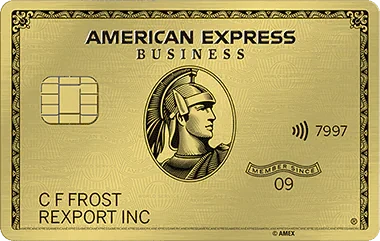
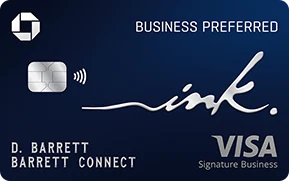
TL;DR: The Amex Business Gold ($375 AF) earns 4x Membership Rewards on the top 2 of six eligible categories each billing cycle (airfare direct, U.S. advertising, gas, restaurants, shipping, software/cloud) up to $150,000/year combined, plus $240/year in flexible business credits. The Chase Ink Business Preferred ($95 AF) earns 3x Ultimate Rewards on travel, shipping, internet/cable/phone, and advertising purchases up to $150,000/year combined, plus cell phone protection (up to $1,000/claim) and trip cancellation coverage. Business Gold wins on earn rate when your spend is concentrated in its categories; Ink Preferred wins on cost-efficiency, Hyatt and United transfer access, and travel protections.
At a glance
| Amex Business Gold | Chase Ink Business Preferred | |
|---|---|---|
| Annual fee | $375 | $95 |
| Effective fee after credits | ~$135 (after $240 flexible credits) | $95 |
| Core earn | 4x on top 2 of 6 categories (auto, up to $150K/yr combined) | 3x on travel, shipping, advertising, internet/cable/phone (up to $150K/yr combined) |
| Secondary earn | 1x everything else | 1x everything else |
| Points currency | Membership Rewards (transferable) | Ultimate Rewards (transferable) |
| Cell phone protection | — | Yes — up to $1,000/claim, $100 deductible, 3 claims/yr |
| Trip cancellation/interruption | — | Yes — up to $5,000/person |
| Foreign transaction fee | $0 | $0 |
| Welcome bonus | Once-per-lifetime | Available every 24+ months |
| 5/24 impact | Does not appear on personal report (most cases) | Does not appear on personal report, but Chase counts the inquiry |
The $280 fee difference is real — but so is the earn difference. Whether that gap is worth it depends entirely on where your business spends money.
How each card earns
Amex Business Gold — 4x automatic category logic
The Business Gold's engine recalculates every billing cycle. Amex looks at your spend across six eligible categories — airfare bought directly from airlines, U.S. advertising (online, TV, radio, print), U.S. gas stations, U.S. restaurants, U.S. shipping, and software/cloud-system providers — and applies 4x Membership Rewards to the top two. You do not enroll or choose categories; the system adapts automatically.
The 4x cap is $150,000 in combined bonus-category spend per calendar year. At $150,000 × 4x = 600,000 Membership Rewards. At a conservative 1.5 cents per point (Air France/KLM Flying Blue, Avianca, and many other partners regularly yield that or more), that is $9,000 in travel value from a single card on maxed-out category spend.
Layer in the $240/year in flexible business credits (monthly statement credits at FedEx, Grubhub, and other eligible merchants) and the effective annual fee is roughly $135 — a price easier to swallow alongside a 4x return.
The catch: outside those top two categories, the Business Gold earns 1x. A business with diffuse spend across many categories will bleed earn rate on everything that does not make the top-two cut.
Chase Ink Business Preferred — 3x on five fixed categories
The Ink Business Preferred earns 3x Ultimate Rewards on a broader, fixed list: travel (including transit and hotels), shipping purchases, advertising purchases (online, social, search), internet/cable/phone service, and, somewhat uniquely among business cards, video-game purchases. The $150,000/year combined cap is the same as Business Gold's.
At $150,000 × 3x = 450,000 Ultimate Rewards. At 2 cents per point via Hyatt transfers (where points routinely deliver 2–2.5cpp in premium rooms), that is $9,000 — matching the Business Gold's dollar-value output despite the lower rate, because Hyatt transfers out-value most Membership Rewards redemptions on a per-point basis.
The $95 fee is the Ink Preferred's structural advantage. A business earning 300,000 points per year saves $280 in annual fees versus the Business Gold — that is 280,000 extra points at a 1cpp baseline that the Business Gold user never gets to spend.
Beyond points, the Ink Preferred bundles real business-relevant protections: cell phone protection (up to $1,000 per claim, $100 deductible, 3 claims per year, when you pay your phone bill with the card) and trip cancellation/interruption insurance (up to $5,000 per person). Neither benefit exists on the Business Gold.
Transfer partner comparison
This is where the real divergence lives. Both cards earn transferable points — but into different ecosystems. Amex points flow into the Membership Rewards program, while Chase points flow into Ultimate Rewards.
| Amex Membership Rewards | Chase Ultimate Rewards | |
|---|---|---|
| Airline partners | Delta, British Airways, Air France/KLM Flying Blue, Avianca, Iberia, ANA, Air Canada Aeroplan, Cathay, Emirates, Singapore, Qantas, Virgin Atlantic, and more | United, Southwest, British Airways, Air France/KLM Flying Blue, Iberia, Air Canada Aeroplan, Singapore, Aer Lingus, Virgin Atlantic, and more |
| Hotel partners | Marriott, Hilton, Choice, Leaders Club (LHW) | Hyatt, Marriott, IHG, Wyndham |
| Transfer ratios | 1:1 on most | 1:1 on all |
| Hyatt access | No | Yes — best hotel program for points value |
| United access | No | Yes — strong for domestic and international |
| Delta access | Yes | No |
| Emirates access | Yes | No |
| ANA access | Yes — direct 1:1 transfer | No |
| Lufthansa access | Indirect — via ANA or Aeroplan miles | Indirect — via Aeroplan miles only |
The verdict on transfer partners splits cleanly: if you want Hyatt or United, you need Ultimate Rewards. If you want Delta, Emirates, or ANA, you need Membership Rewards. Neither bank transfers directly to Lufthansa — it isn't a partner of either program — but Lufthansa's Star Alliance premium cabins are bookable with ANA or Aeroplan miles, and Membership Rewards reaches both while Ultimate Rewards only reaches Aeroplan, making MR the stronger indirect route to Lufthansa metal. Many serious points travelers hold cards from both ecosystems for exactly this reason — a strategy sometimes called the Amex trifecta on the Amex side.
Spend scenario: who wins
Scenario 1 — Heavy U.S. ad spend + shipping
A DTC brand spending $80,000/year on U.S. advertising and $40,000/year on U.S. shipping:
- Business Gold: Both categories likely hit the top-two threshold → 4x on $120,000 = 480,000 MR. Effective fee ~$135.
- Ink Preferred: 3x on advertising + 3x on shipping = $120,000 × 3x = 360,000 UR. Fee $95.
Business Gold produces 120,000 more points, but the 120,000 MR premium at 1.5cpp = $1,800 in value. After accounting for the $280 extra in fees, the net advantage is $1,520/year — Business Gold wins for this business, assuming you value MR at 1.5cpp or above.
Scenario 2 — Moderate spend across travel + phone + ads
A consulting firm spending $15,000 on travel, $12,000 on online advertising, and $3,000 on internet/phone:
- Business Gold: Travel may or may not be top-2 (depends on other categories). Assume 4x on $27,000 = 108,000 MR. Fee ~$135.
- Ink Preferred: 3x on all three categories = $30,000 × 3x = 90,000 UR + cell phone protection + trip insurance. Fee $95.
Ink Preferred gives 18,000 fewer points but costs $40 less in effective fees, adds tangible insurance benefits, and — if you value UR at 2cpp via Hyatt — produces $1,800 in value vs. Business Gold's $1,620 at 1.5cpp MR. Ink Preferred wins here.
Scenario 3 — Low-volume, spread-out spend
A small service business with $30,000 total spend across many categories:
- Business Gold: 4x on the top two categories (say $8,000 combined) = 32,000 MR, rest at 1x = 22,000 MR. Total 54,000 MR. Fee ~$135.
- Ink Preferred: If $10,000 falls in 3x categories = 30,000 UR + $20,000 at 1x = 20,000 UR. Total 50,000 UR. Fee $95.
Nearly tied on points. Ink Preferred wins easily on cost. Add cell phone protection: a single $1,000 phone claim covers 10+ years of the fee difference.
The 5/24 and application rules difference
This is practically important for anyone building a multi-card strategy.
Chase Ink Business Preferred: Chase business cards generally do not appear on your personal credit report (they won't count as a slot toward Chase's informal 5/24 rule). However, applying for a Chase business card does trigger a hard pull, and Chase does appear to consider recent application velocity. The welcome bonus is available every 24+ months per product.
Amex Business Gold: Amex business cards do not appear on your personal credit report. The welcome bonus is once-per-lifetime per product — you can only earn it once, ever. Amex also has its own application velocity rules (typically 1 card per 5 days, 2 per 90 days, 4 per year for business cards).
For most business owners building a points strategy, the Ink Preferred's renewable bonus is a meaningful advantage over the Business Gold's once-per-lifetime structure.
Which should you pick
Pick the Amex Business Gold if:
- Your business spends $50,000+ per year heavily concentrated in U.S. advertising, shipping, gas, restaurants, or software
- You want access to Delta, Emirates, or ANA transfer partners — including indirect access to Lufthansa's premium cabins via ANA or Aeroplan miles
- You already have a Chase Sapphire card and want to diversify into a second points ecosystem
- You can reliably use all $240/year in flexible business credits
Pick the Chase Ink Business Preferred if:
- Your business spends across travel, shipping, ads, and internet/phone with no single dominant category
- You want Hyatt or United transfer access (the highest-value hotel and a top domestic airline)
- You travel frequently and want trip cancellation insurance and cell phone protection
- You are cost-conscious and the $95 fee fits better than $375 (or ~$135 effective)
- You want the ability to earn the welcome bonus again after 24 months
Hold both if:
- You have high spend in Business Gold's 4x categories AND frequent travel that benefits from Hyatt/United
- You want dual-ecosystem coverage: MR for Delta/Emirates, UR for Hyatt/United
- Your combined annual card spend justifies two fee structures
If budget is a constraint or you are early in your points journey, the Ink Preferred at $95 is the safer starting card. If you are a high-spend business that loves Amex's ecosystem and is willing to pay $375 (or ~$135 after credits) for a higher earn rate, the Business Gold delivers more raw points on concentrated spend.
For a no-annual-fee backup that still earns in the Amex ecosystem, the Blue Business Plus earns 2x Membership Rewards on the first $50,000/year of all purchases — a useful third-card addition once you hold both flagship cards. And if you want more Chase cards in the mix, the Chase Ink business card lineup includes the Ink Cash and Ink Unlimited, both with no annual fee and pooling into the same Ultimate Rewards balance.
Bottom line
The Amex Business Gold is the high-earn, higher-cost pick for spend-concentrated businesses. The Chase Ink Business Preferred is the cost-efficient, protection-rich, Hyatt-accessible pick for businesses with more evenly spread spend. If you can use the Business Gold's $240 in flexible credits and your spend heavily hits its 4x categories, the ~$135 effective fee buys one of the best earn rates in business cards. If your spend is more diverse and you want Hyatt/United access plus real insurance coverage, the Ink Preferred at $95 wins outright.
Get weekly card offer alerts
Sunday digest of elevated bonuses. One email, zero spam.
Cards mentioned in this guide
Frequently asked questions
Is the Amex Business Gold worth $375 vs the Ink Preferred at $95?
Which card is better for Hyatt transfers?
Can I hold both the Amex Business Gold and the Chase Ink Business Preferred?
Related guides
Related news

chase · Jun 2, 2026
Chase Ink Preferred 100K Returns: 2026 Ink Lineup

chase · Jun 10, 2026
Chase Hyatt Transfer Ratio 4:3: What It Means for Sapphire Preferred and Ink Business Preferred

chase · Jun 10, 2026
Chase to Virgin Atlantic: 30% Transfer Bonus — Book Delta Business Class for 18,000 Points

hyatt · Jun 3, 2026
Hyatt Added Perk for Globalists, Explorists and Cardholders
Cards in this ecosystem


Considering switching?