Best Business Credit Cards for Points & Rewards 2026
Best business credit cards for sole proprietors, freelancers, and small businesses — no LLC or EIN required. Compare Chase Ink, Amex Business, and Capital One Spark.
On this page▾

Topic Collection
Part of the Business Credit Cards Collection
Explore all 37 articles
Quick answer
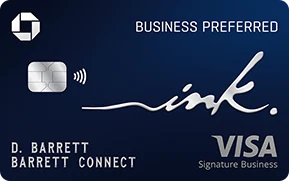
The best small business credit card for most people is the Ink Preferred — large welcome bonus, 3x on travel and key business categories, and UR points transferable to Hyatt, United, and 12 other partners. If you want no annual fee, Ink Cash (5x on office/telecom) or Blue Business Plus (2x flat) are the top picks. Read on for the full breakdown by business type.
Do you need an LLC or EIN to get a business credit card?
No — and this is the most important thing to know before applying.
You do not need an LLC, corporation, registered business, EIN, or business bank account to apply for most business credit cards. Banks define "business" broadly enough to include sole proprietors using their personal SSN.
What counts as a business:
- Freelancing or consulting (any field — design, writing, coding, accounting, legal, tutoring)
- Selling products online (eBay, Etsy, Amazon, Mercari, Poshmark)
- Renting property on Airbnb or VRBO
- Driving for rideshare or delivery (Uber, Lyft, DoorDash, Instacart)
- Photography, videography, or creative services
- Landscaping, cleaning, handyman work
- Any side income at any scale — even $500/year qualifies
EIN vs SSN — what to enter on the application:
An EIN (Employer Identification Number) is a free tax ID issued by the IRS, typically needed if you have employees or an LLC/corporation. If you're a sole proprietor, single-member LLC, or have no employees, you can use your SSN where the application asks for a Tax ID number. Chase and Amex both accept SSNs from sole proprietors. Getting an EIN is free at IRS.gov if you want to separate your business and personal identity — but it is never required for card approval.
Top cards by business type
Best for general small business: Ink Preferred
3x points on shipping, advertising, travel, and internet/cable/phone services (on the first $150,000 in combined purchases per year). The largest welcome bonus of the three Ink cards. $95 annual fee. Points transfer 1:1 to Hyatt, United, Singapore Airlines, and 11 more Chase partners.
Best for: Any business that spends on ads (Google, Meta, LinkedIn), shipping, or internet/phone.
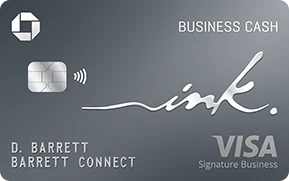
Best no-annual-fee business card: Ink Cash
5x on office supplies and internet, cable, and phone services (up to $25,000/year). 2x on gas stations and restaurants. $0 annual fee. Points are UR and become fully transferable if you also hold a Sapphire or Ink Preferred.
Best for: Office-heavy businesses, remote workers, anyone with significant internet/phone bills.
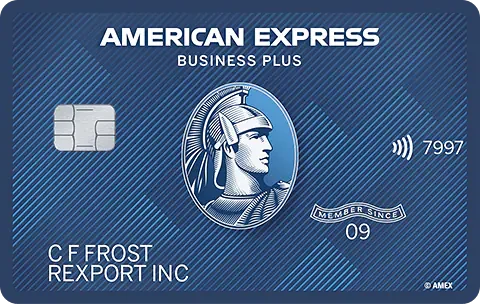
Best flat-rate no-fee card: Blue Business Plus
2x Amex Membership Rewards on all purchases up to $50,000/year, then 1x. No annual fee. Transfers to Air Canada Aeroplan, British Airways, Delta SkyMiles, and 16 more Amex partners at 1:1.
Best for: Businesses with varied spending that doesn't fit neatly into bonus categories.
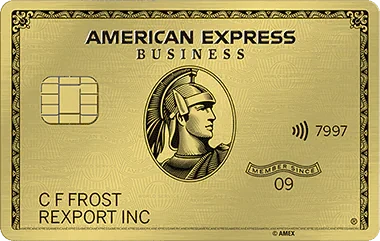
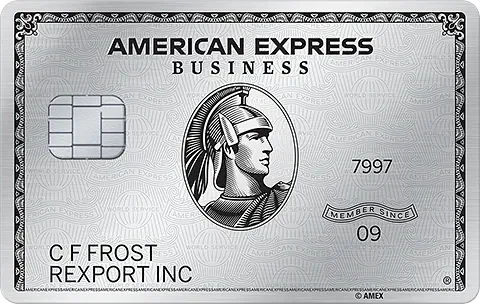
Best premium business card: Amex Business Platinum
5x MR on flights and hotels booked through Amex Travel. 1.5x MR on purchases of $5,000 or more (up to $2M/year). Access to 40+ Centurion Lounges and 1,300+ Priority Pass lounges. $200 airline fee credit, $400 Dell credit, $200 Indeed credit, $150 Adobe credit. $695 annual fee.
Best for: High-volume businesses spending $50K+/year, frequent flyers needing lounge access, consultants billing large invoices.
Best for flexible category earn: Amex Business Gold
4x MR on the 2 categories where you spend the most each month (automatically rotates across 6 categories: airfare, advertising, gas, restaurants, shipping, and technology/cloud). Cap at $150,000/year. $375 annual fee.
Best for: Businesses with high but variable category spend — the automatic category selection removes the tracking burden.
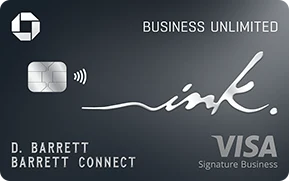
Best catch-all flat rate: Ink Unlimited
1.5x UR on every purchase, no categories to track. $0 annual fee. Pairs perfectly with Ink Preferred to make the 1.5x transferable.
Best for: Adding to an existing Ink stack, or any business that wants dead-simple rewards.
Sole proprietors: the complete application guide
If you're applying as a sole proprietor, here's exactly how to fill out the application:
| Field | What to enter |
|---|---|
| Business name | Your own full legal name (or any DBA name you use) |
| Business type | Sole proprietor |
| Business tax ID | Your SSN (same as your personal Social Security number) |
| Years in business | Estimate — even "less than 1 year" is acceptable |
| Annual business revenue | Your estimated annual income from the business activity |
| Number of employees | 0 (or 1 if counting yourself) |
Common approval factors for sole proprietors:
- Personal credit score (670+ is a safe target; 720+ is strong)
- Thin credit history is not automatically disqualifying; Amex is known to approve applicants with shorter US credit history
- Business revenue helps but is not verified — reasonable estimates are fine
- Prior Chase relationship (existing cards, checking account) helps with Ink applications
If denied: Wait 90 days and reapply, or request reconsideration if you believe the denial was borderline. For Chase, a reconsideration call sometimes succeeds for business cards when a human reviewer sees your business income.
Side hustle and freelancer use cases
You don't need to think of yourself as a "business owner" to qualify for a business card. If any of these describe you, you qualify:
- You do contract work (1099 income) for any client
- You sell things online occasionally for profit
- You drive for gig platforms
- You rent out a room or property
- You provide services to neighbors, friends, or local businesses
What to say on the application: For business name, use your name + what you do ("Jane Smith Photography"). For business type, select Sole Proprietor. For revenue, use a realistic estimate of your annual income from the activity.
Ink Trifecta: the small business power setup
For small businesses that want to maximize every dollar:
- Ink Preferred — anchor card, enables transfers ($95/year)
- Ink Cash — office/telecom at 5x ($0/year)
- Ink Unlimited — everything else at 1.5x ($0/year)
Total cost: $95/year for three cards with comprehensive category coverage. All points pool onto the Preferred and transfer to Chase's 14 airline and hotel partners. Apply for them 90 days apart — each has a separate welcome bonus.
See: Chase Ink Cards Guide | Ink vs Ink vs Ink: Which First?
Get weekly card offer alerts
Sunday digest of elevated bonuses. One email, zero spam.
Cards mentioned in this guide

Frequently asked questions
Do I need an LLC to get a business credit card?
Can a freelancer or gig worker get a business credit card?
What is the best business credit card with no annual fee?
Related guides
Rules & Mechanics
Business Credit Cards for Sole Proprietors 2026
12 min
Rules & Mechanics
Can I Get a Business Credit Card? (Complete 2026 Guide)
10 min
Strategy
Sapphire Reserve Business vs Amex Business Platinum
20 min
Strategy
How to Get Approved for a Business Credit Card in 2026 (Even Without Business Revenue)
10 min
Related news

chase · Jun 2, 2026
Chase Ink Preferred 100K Returns: 2026 Ink Lineup

amex · Jun 2, 2026
Amex 30% Avios Transfer Bonus: 1,000 MR = 1,300 Avios, Ends ~June 21 2026

chase · Jun 10, 2026
Chase Hyatt Transfer Ratio 4:3: What It Means for Sapphire Preferred and Ink Business Preferred

chase · Jun 10, 2026
Chase to Virgin Atlantic: 30% Transfer Bonus — Book Delta Business Class for 18,000 Points