Business Credit Card vs Personal Credit Card (2026): Key Differences
Expense separation, credit bureau reporting, 5/24 implications, personal guarantee, CARD Act protections, and welcome bonus rules — everything you need to decide whether to get a business credit card.
On this page▾

Topic Collection
Part of the Business Credit Cards Collection
Explore all 37 articles
Most small business owners carry a personal credit card and assume it is good enough for business expenses. It usually is — until it is not. A business credit card does several things a personal card structurally cannot: separates business and personal expenses automatically, provides higher credit limits sized for business cash flow, lets you issue employee cards with individual limits, and keeps business spending off your personal credit report. The tradeoff is qualification, annual fees, and sometimes fewer consumer protections.
This guide breaks down every meaningful difference between business and personal credit cards, explains who genuinely needs a business card, and walks through the four major issuers' rules on welcome bonuses and credit bureau reporting.
Quick answer
TL;DR: A business credit card keeps business and personal finances separate, typically reports only to business credit bureaus (not your personal report), offers higher credit limits sized for B2B cash flow, allows employee cards with individual limits, and provides expense categorization. Welcome bonuses on Amex and Capital One business cards do not count against Chase's 5/24 rule (the card itself doesn't appear on your personal report), but Chase business cards do count toward Chase's own application-velocity tracking. Personal cards have stronger consumer protections under the CARD Act; business cards are generally exempt.
The core differences at a glance
| Business Credit Card | Personal Credit Card | |
|---|---|---|
| Expense separation | Hard boundary — all charges on one card, categorized | Mixed with personal spend unless you self-discipline |
| Credit limit | Typically higher — sized for payroll, inventory, vendor payments | Sized for personal spending |
| Reports to personal credit | Usually no (Amex, Chase, Capital One biz cards don't) | Yes — utilization affects personal score |
| Reports to business credit | Yes — builds Dun & Bradstreet, Experian Business profile | No |
| Employee cards | Yes — sub-limits, individual tracking | Authorized users only, no individual limits |
| CARD Act protections | Exempt — issuers can change terms faster | Full CARD Act protections |
| Welcome bonus | Often larger | Typically smaller |
| Liability | Personal guarantee required (traditional business cards) | Personal liability only |
| Tax deduction | Business expenses deductible; card makes tracking easy | Must manually separate |
| Welcome bonus counting toward 5/24 | Most don't appear on personal report | All count toward 5/24 |
Expense separation: the operational case for a business card
The most underrated reason to get a business credit card is not points — it is cleanliness. Every dollar that goes on a business card is automatically a business expense. Come tax time, you export a statement, hand it to your accountant or plug it into your bookkeeping software, and the work is done. No line-by-line sorting of a personal card for the restaurant that was a client dinner versus the one that was personal.
The IRS does not require a separate business account or card — you can deduct legitimate business expenses charged to a personal card. But a dedicated business card makes documentation bulletproof and audit risk minimal — a process we walk through in depth in our guide to how to separate business and personal expenses. For a sole proprietor filing a Schedule C, the time savings alone justify the card.
For a business with employees, the case is even stronger. Business cards let you issue employee cards with individual spending limits. A personal card issued as an authorized-user card to an employee gives that employee full access to your personal credit line with no individual cap. Business cards fix this with per-employee sub-limits and detailed transaction reporting — see the full breakdown in our guide to employee cards strategy.
Credit bureau reporting: why it matters more than most people realize
Most major business cards — including Amex business cards, Chase business cards, and Capital One business cards — do not report to personal credit bureaus under normal usage. Your credit utilization ratio, which is one of the highest-impact factors in a personal FICO score, is unaffected by what you put on a business card.
This is a structural advantage for high-volume business spenders. A business owner who puts $20,000/month on a business card and carries a balance briefly would see that utilization crush their personal score on a personal card. On a business card, it does not appear.
The flip side: business cards do report to business credit bureaus (Dun & Bradstreet, Experian Business, Equifax Business). If you want to build a business credit profile — which matters for commercial loans, leases, and vendor payment terms — you need business cards reporting to those bureaus.
One exception worth knowing: Capital One does report some business card activity to personal bureaus. Check Capital One's current terms if this matters for your personal credit planning.
The 5/24 rule and welcome bonus eligibility
This is where business card strategy gets nuanced, and where the issuer matters enormously.
Chase
Chase has an informal rule known as "5/24": if you have opened 5 or more new credit card accounts in the last 24 months (counting accounts on your personal credit report), Chase will decline most new card applications — the full mechanics are explained in our Chase 5/24 rule guide. The critical detail for business cards:
- Chase business cards (Ink series) do NOT appear on your personal credit report in most cases — see how Ink cards interact with 5/24 for the nuances. A Chase Ink Business Preferred you open today will not add to your 5/24 count next time you apply.
- BUT: Chase does track application velocity internally. Applying for Chase business cards too frequently can trigger declines even below 5/24.
- The hard pull from a Chase business application DOES appear on your personal report temporarily, but the card account itself does not.
The Ink Preferred is the most common first business card in a Chase points strategy because it does not eat a 5/24 slot.
American Express
Amex business cards do not appear on your personal credit report at all, in any meaningful way. They do not count toward 5/24. The key Amex-specific rule is the once-per-lifetime welcome bonus: each Amex card product can only be earned once. If you received the Amex Business Gold welcome bonus five years ago and canceled the card, you cannot earn it again. Amex also has its own velocity limits (generally 1 card per 5 days, 2 per 90 days, 4 per year for business cards).
Capital One
Capital One business cards have a mixed picture. The Spark Cash Plus and related Capital One business cards have historically not counted toward Chase's 5/24 because they do not appear on personal reports — but Capital One does report some business card activity to personal bureaus. Capital One also applies its own velocity rules; applying for multiple Capital One cards in a short window typically results in declines.
Liability: personal guarantee vs. corporate liability
Traditional business credit cards — from Amex, Chase, and Capital One — require a personal guarantee. This means if your business cannot pay the balance, you are personally responsible. Your personal credit and assets are on the line.
This is different from true corporate charge cards (like those from Ramp or Brex for qualifying companies), which can extend credit based on the company's financial profile without a personal guarantee. For a sole proprietor or a small LLC, a personal guarantee is essentially unavoidable on traditional business credit cards; it is the price of access to business credit limits before your business has an independent credit history.
What the personal guarantee does NOT do: it does not make business card spending count toward your personal credit utilization ratio (for most issuers). The liability exposure and the credit reporting are separate mechanisms.
Consumer protections: a real gap
The Credit CARD Act of 2009 gives personal cardholders strong protections: 45-day advance notice before rate changes, limits on retroactive rate increases, restrictions on over-limit fees, and more. Business credit cards are explicitly exempt from most CARD Act provisions.
In practice, major issuers (Amex, Chase, Capital One) voluntarily apply many CARD Act-style protections to their business cards — but they are not legally required to do so, and terms can change faster. Read your business card's terms for rate-change notice periods and fee structures; do not assume they match your personal card.
Who actually needs a business credit card
You should have a business card if:
- You have any business income — freelance, consulting, e-commerce, side hustle, or established company
- You want to build business credit separate from personal credit
- You have employees who need spending authority
- Your monthly business expenses exceed $2,000–$3,000 and you want clean expense separation
- You want access to welcome bonuses that do not count against 5/24 (Amex, Chase Ink)
- You want a higher credit limit than your personal card allows
A personal card may be sufficient if:
- Your business is a true side hustle with under $500/month in expenses
- You have no employees and prefer simplicity
- You are early in a points strategy and still accumulating 5/24-eligible cards
Which business card to start with
For most first-time business cardholders, the Ink Preferred at $95/year is the most versatile starting card: 3x Ultimate Rewards on travel, shipping, advertising, and internet/phone up to $150,000/year, Hyatt and United transfer access, cell phone protection, and a renewable welcome bonus. It does not eat a 5/24 slot.
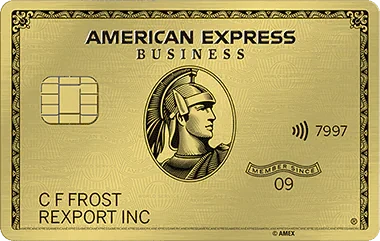
For a business that spends heavily in advertising, shipping, or software and wants the highest possible earn rate, the Amex Business Gold at $375 (effective ~$135 after $240 in flexible credits) earns 4x Membership Rewards automatically on the top two eligible categories each billing cycle.
For a completely no-fee business card that still earns transferable points, the Blue Business Plus earns 2x Membership Rewards on the first $50,000/year of all purchases with no categories to track — our Amex Blue Business Plus review has the full rundown.
If you want to stay in the Chase ecosystem with no annual fee, the Ink Cash earns 5x on office supplies and internet/cable/phone (up to $25,000/year combined) and 2x on gas and dining — both stackable with a Chase Sapphire card to unlock transfer partners.
Bottom line
A business credit card is worth getting as soon as you have any legitimate business income. The expense separation, the impact on your personal credit score (minimal), the employee card features, and the welcome bonuses that do not count against 5/24 all create structural advantages over a personal card. The CARD Act gap is a real consideration, but the major issuers apply most of those protections voluntarily. Start with the Chase Ink overview to compare Ink card options, or explore best Amex business cards if you want MR ecosystem access from day one.
Get weekly card offer alerts
Sunday digest of elevated bonuses. One email, zero spam.
Cards mentioned in this guide



Frequently asked questions
Do business credit cards show up on my personal credit report?
Do I need an LLC to get a business credit card?
Does getting a business credit card hurt my personal credit?
Related guides
Related news

chase · Jun 10, 2026
Chase Hyatt Transfer Ratio 4:3: What It Means for Sapphire Preferred and Ink Business Preferred

chase · Jun 10, 2026
Chase to Virgin Atlantic: 30% Transfer Bonus — Book Delta Business Class for 18,000 Points

airlines · Jun 4, 2026
Alaska Atmos Members Day Launched

hyatt · Jun 3, 2026
Hyatt Added Perk for Globalists, Explorists and Cardholders