How to Rent an Apartment in the US With No Credit History (2026)
A newcomer with no US credit history rents an apartment by replacing the missing FICO score with stronger proof the landlord can trust: a lease-guarantor service (TheGuarantors, Insurent, Leap — fee typically 70-100% of one month’s rent), a US co-signer, a larger security deposit, several months of prepaid rent, or income proof around 40x the monthly rent via pay stubs, an employment offer letter, and bank statements. After move-in, a rent-reporting service and {{card:bilt-blue}} turn the rent into credit history and points.
On this page▾

Topic Collection
Part of the New to America Collection
Explore all 37 articles
Quick answer
You can rent a US apartment with no credit history by replacing the credit score landlords usually check with stronger proof: income, a guarantor service, a co-signer, a larger deposit, or prepaid rent. Newcomers who lead with documents — pay stubs or an employment offer letter showing roughly 40x the monthly rent, bank statements, and a clean rental story — get approved every day. Then turn that rent into a credit asset with a rent-reporting service and a card like Bilt Blue that earns points on the payment.
TL;DR: A renter with no US credit history gets approved by substituting other proof of reliability for a FICO score. The strongest substitutes in 2026 are: a lease-guarantor service (TheGuarantors, Insurent, Leap — fee typically 70-100% of one month's rent), a co-signer with US credit, a larger security deposit, several months of rent prepaid, and income proof around 40x monthly rent via pay stubs, an employment letter, or bank statements. After move-in, rent-reporting services and Bilt Blue (1 point per $1 of rent, up to 100,000 points/year, no transaction fee) add the rent payment to a credit file and earn points on it.
What landlords actually check
A landlord or property manager is screening for one thing: will you pay rent in full and on time for the length of the lease. To predict that, a typical US application runs a credit check (your FICO score and report) and a background check (eviction history, criminal record, identity verification). They also verify income and often call past landlords or employers.
If you just arrived in the US, your credit report is thin or empty. That is not a rejection by itself — it is a missing data point the landlord has to fill another way. Your job is to hand them that other way before they have to ask.
No-credit rental options at a glance
| Option | How it helps | Typical cost |
|---|---|---|
| Lease-guarantor service | Third party guarantees your rent; landlord treats you as low-risk | 70-100% of one month's rent |
| Co-signer | Relative/friend with US credit signs the lease with you | Free (but they're liable) |
| Larger security deposit | Extra cash reduces landlord's risk | 1-3 extra months held |
| Prepaid rent | Pay several months up front | 2-6 months of rent up front |
| Income proof (~40x rent) | Pay stubs / offer letter show you can afford it | Free |
| Bank statements | Cash reserves prove staying power | Free |
Credit requirements decoded
Landlords quote their thresholds in two different units and almost never explain either one, so decode the listing before you assume you fail it.
| What the listing says | What it actually means | Where a newcomer stands |
|---|---|---|
| Income 40x monthly rent | Annual gross income of at least 40 times the rent, so a $2,000 apartment needs $80,000 a year | Provable with an offer letter alone |
| Income 3x monthly rent | Monthly gross income of at least 3 times the rent, slightly looser than the 40x rule | Provable with two pay stubs |
| Minimum credit score 650-700 | One FICO pulled from a single bureau, usually TransUnion or Experian | Comes back as no score, not a low one |
| No prior evictions | A court-records search, run separately from the credit pull | Usually clean and quick to verify |
The third row is the one newcomers misread, and it is the one that decides the application. A thin file does not return a bad score. It returns insufficient data to score, and inside the screening software that is a different outcome entirely: an applicant at 540 is frequently auto-declined by rule, while an applicant with no score is routed to a human for manual review. That human is exactly who your packet is written for.
Key takeaway: no score is not a failing score, and that distinction is what determines whether a person ever reads your application at all.
The options that actually work for newcomers
Lease-guarantor services
A lease-guarantor service is the single most reliable fix for a missing US credit history. Companies like TheGuarantors, Insurent, and Leap act as a co-signer on the landlord's behalf: they promise the landlord your rent will be paid, so the landlord can approve you as if you had strong credit. You qualify based on income (these services often accept lower income multiples than landlords do) rather than a US score, and many evaluate international income or savings.
The cost is a one-time fee, typically 70-100% of one month's rent. On a $2,000 apartment, expect roughly $1,400-$2,000. It is not cheap, but it can be the difference between getting the lease and losing it — and it is often cheaper than the alternative of prepaying six months.
A co-signer
If you have a relative or close friend who is a US resident with established credit, they can co-sign the lease. They become legally responsible for the rent if you don't pay, which is exactly the assurance the landlord wants. Ask only someone who understands the commitment — a missed payment hits their credit, not just yours.
A larger security deposit or prepaid rent
Cash solves a lot. Offering one to three extra months as a security deposit, or prepaying several months of rent, directly reduces the landlord's exposure. Many independent landlords will take this deal even when a large management company won't. Get any extra deposit or prepayment terms in writing in the lease, including how and when the deposit is returned.
Proof of income and employment
A landlord who can't see a credit score will lean hard on income. The common bar is monthly income around 40x the rent — for a $1,500 apartment, that's roughly $60,000 a year. Bring:
- Recent pay stubs (last 2-3 months)
- An employment offer letter on company letterhead stating salary and start date (gold for new arrivals who haven't been paid yet)
- Bank statements showing savings and reserves
- A letter from your employer's HR confirming the role
If you are on an H-1B, L-1, O-1, or a student or exchange visa, include a copy of your visa or I-797 approval to show your legal right to stay for the lease term.
How to present a strong application
You control the story. Walk in with a single PDF packet so the landlord never has to chase you for a document.
- One-page cover summary. Name, role and employer, monthly income, move-in date, and one line: "New to the US, no domestic credit history yet — here's my full financial picture."
- Income proof. Pay stubs, offer letter, last 2-3 months of bank statements.
- A guarantor or co-signer offer up front. State that you can use TheGuarantors/Insurent/Leap or provide a US co-signer — don't wait to be asked.
- References. A previous landlord (even abroad) and a professional reference. A short letter beats a phone number.
- An offer of extra deposit. Naming a number ("I can place two extra months as a deposit") signals seriousness.
- Visa or work authorization. Shows you'll legally be there for the full term.
Apply quickly once you find a unit. In competitive markets the renter who hands over a complete packet the same day usually wins over one with better credit who is slow and disorganized.
Turn rent into credit history
The same rent that was a barrier can become your fastest credit-building tool once you're in.
Rent-reporting services
Most landlords don't report your on-time rent to the bureaus by default, so it doesn't help your score — unless you route it through a rent-reporting service. These services (Bilt offers one; standalone options exist too) report your monthly rent payment to one or more of Experian, TransUnion, and Equifax, adding a positive tradeline to your file. For a newcomer with no other accounts, a year of reported on-time rent can be the foundation of a real FICO score. Confirm which bureaus a service reports to before signing up — coverage varies.
Earn points on rent with Bilt
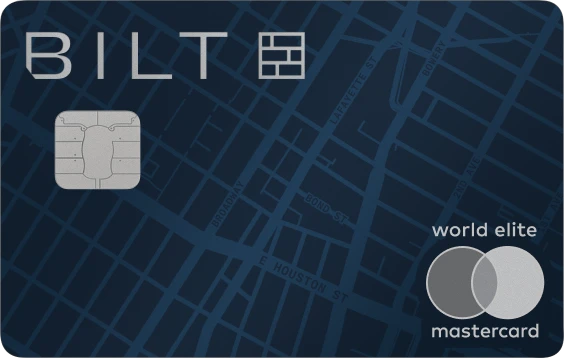
Bilt Blue is built for renters. It earns 1 point per $1 of rent (up to 100,000 points per year) with no transaction fee — virtually every other card either refuses rent or charges 2-3% to process it. There is no annual fee. Bilt Card 2.0 also removed the 5-transaction monthly minimum that the original Bilt Mastercard (retired — closed to new applicants) required.
On a $1,500 apartment, that's 18,000 Bilt points a year on money you were spending anyway, plus the rent payment itself can feed a rent-reporting tradeline. Pair Bilt with a simple no-fee everyday card such as Quicksilver for flat cash back on the rest of your spending, and your rent quietly builds both points and credit.
Common mistakes
- Waiting to be asked about credit. Lead with your documents. Volunteering a guarantor or extra deposit before the landlord raises the credit issue keeps you in control.
- Applying with a thin packet. A name and a phone number lose to a complete PDF every time. Assemble it once and reuse it for every unit.
- Assuming on-time rent builds credit automatically. It doesn't unless a rent-reporting service is sending it to the bureaus.
- Paying rent with a regular card through a third-party processor. The 2-3% fee usually wipes out any rewards. Use Bilt Blue (no fee) instead.
- Not getting extra-deposit or prepayment terms in writing. Verbal promises about returning a large deposit are hard to enforce. Put it in the lease.
Bottom line
No US credit history is a solvable problem, not a wall. Substitute proof the landlord can trust — income near 40x rent, a guarantor service at 70-100% of a month's rent, a co-signer, or a larger deposit — and present it all in one clean packet before anyone has to ask. Once you're in, route the rent through a rent-reporting service and pay it with Bilt Blue so the expense you can't avoid starts building your score and earning points. Add Quicksilver for everyday spend, and within a year you go from no credit to a real, rent-anchored file.
Get weekly card offer alerts
Sunday digest of elevated bonuses. One email, zero spam.
Cards mentioned in this guide

Frequently asked questions
Can I really rent in the US with no credit history at all?
How much does a lease-guarantor service cost?
What income do I need to qualify for an apartment?
Does paying rent on time build my credit score?
How does Bilt let me earn points on rent without a fee?
Is a co-signer or a guarantor service better?
Related guides
Related news

bilt · Jun 2, 2026
Bilt Rent Day June 2026: TAP 25-125% Bonus Explained

bilt · Jun 2, 2026
Bilt 2.0 at 6 Months: What Worked, What Backfired

amex · Jun 25, 2026
Amex Platinum vs Schwab Platinum: the same $895 card, with a cash-out

chase · Jun 10, 2026
Chase Hyatt Transfer Ratio 4:3: What It Means for Sapphire Preferred and Ink Business Preferred