When Your Business Outgrows Cash Back: Switching to a Points Setup
Move to points only when three things are true together: a meaningful share of your spend falls into bonus categories, you take at least two trips a year you would otherwise pay cash for, and someone in the business will actually do the redeeming. Below that, flat 2 percent cash back wins because it has no worst case. Above it, a points setup typically returns 3 to 5 cents per dollar on the categories that matter. Build it as three cards rather than one: a category earner, a flat catch-all so ordinary spend does not underperform cash back, and a transfer hub. Migrate in stages, keep the cash-back card as your floor, and prove you will redeem before adding the third card.
On this page▾

Topic Collection
Part of the Business Credit Cards Collection
Explore all 42 articles
Two percent cash back is not a beginner setup, it is a floor. It pays 2 cents per dollar with no research, no expiry and no redemption risk, and a points setup only beats it if you actually redeem above 2 cents. The question is not whether points are better in theory. It is whether your business spends in the right places and travels often enough to convert the difference into something real.
Quick answer
Switch when three things are true at once: a meaningful share of your spend falls into bonus categories, you take at least two trips a year you would otherwise pay cash for, and someone in the business will actually do the redeeming. Below that threshold, 2 percent cash back wins on simplicity alone. Above it, a points setup typically returns 3 to 5 cents per dollar on the categories that matter, which on $100,000 of annual spend is the difference between $2,000 and roughly $4,000 of value.
- Cash back returns: a flat, certain 2 cents per dollar
- Points return: 3 to 5 cents on bonus categories, if redeemed well
- The three-part test: category fit, real travel, and someone to do the work
- Below the threshold: stay on cash back
- The usual mistake: switching for the earn rate and never redeeming
💡 Pro tip — Do not switch everything at once. Add one category card to an existing cash-back setup and run both for two quarters. If the points balance is still sitting unredeemed at the end of it, you have your answer and you have lost nothing.
The honest comparison
| Cash back | Points | |
|---|---|---|
| Value per dollar | About 2 cents, certain | 1 to 5 cents, depending on redemption |
| Effort | None | Real and ongoing |
| Expiry risk | None | Programs devalue and points expire |
| Redemption risk | None | An unredeemed balance is worth nothing |
| Best case | 2 percent | Meaningfully more |
| Worst case | 2 percent | Less than 1 percent |
Cash back has no worst case, and that is the whole argument for it. A points setup has a much better best case and a genuinely worse worst case, and which one you land in depends almost entirely on whether you redeem.
Key takeaway: points are not a better product, they are a higher-variance one, and variance only pays if you show up to collect.
The three-part test
1. Does your spend land in bonus categories?
Business spend concentrates differently than personal spend. The categories that carry high multipliers are advertising, shipping, software, phone and internet, and travel. If most of your spend is contractor payments, rent or inventory, it earns 1x almost everywhere and a points setup adds complexity for very little.
2. Do you actually travel?
Points are worth more than cash only when redeemed for travel that you would otherwise buy. Two trips a year is roughly where the maths starts working. If you fly once every other year, the points sit idle, the programs devalue underneath them, and the flat 2 percent you gave up compounds quietly.
3. Will someone do the work?
Someone has to track categories, watch for transfer bonuses, and book awards. In a one-person business that is you. In a larger one it is often nobody, which is how companies end up with a seven-figure spend and an unredeemed balance.
What a points setup actually looks like
The structure is usually three cards, not one.
| Role | What it does | Example |
|---|---|---|
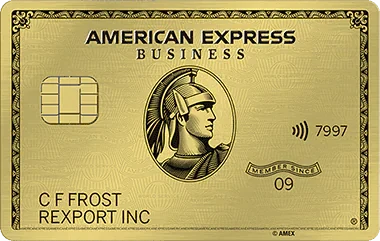
| Category earner | Carries the high multipliers on your biggest categories | Amex Business Gold, which earns 4x on the top two eligible categories each month on the first $150,000 combined per calendar year, then 1x |
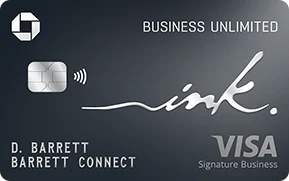
| Catch-all | Everything the category cards do not cover | Ink Unlimited, at a flat 1.5x on all spending |
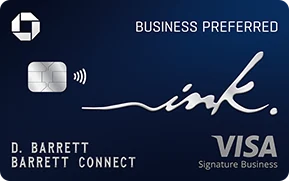
| Transfer hub | Turns the points into flights and hotels | Ink Preferred or a premium personal card |
The catch-all matters more than people expect. A flat 1.5x on everything outside your bonus categories is what stops a points setup from underperforming a 2 percent cash-back card on the majority of your spend.
The switching threshold, roughly
| Annual business spend | Bonus-category share | Verdict |
|---|---|---|
| Under $30,000 | Any | Stay on cash back |
| $30,000-$75,000 | Under 40 percent | Stay on cash back |
| $30,000-$75,000 | Over 40 percent | Add one category card |
| Over $75,000 | Under 40 percent | Add one category card |
| Over $75,000 | Over 40 percent | Full points setup |
These are rules of thumb, not thresholds anyone enforces. The variable that moves them most is travel: a business that spends $40,000 and takes four trips a year gets more from points than one that spends $150,000 and takes none.
How to switch without disruption
- Keep the cash-back card. It becomes your catch-all floor and your fallback if the experiment fails.
- Add one category card aimed at your single largest bonus category.
- Run both for two quarters and compare actual earnings, not projected ones.
- Redeem something before adding a third card. If you cannot complete a redemption, the setup is not working.
- Only then add a transfer hub and start moving points to airline and hotel partners.
- Review annually against the fees you now pay, because a points setup carries them and cash back usually does not.
What goes wrong
Points pile up and nobody books. The single most common failure, and it turns a 4x card into a 1x card retroactively.
Annual fees outgrow the benefit. Three business cards with fees need real spend to justify them; run the break-even before the second renewal.
Category tracking slips. A 4x card used on the wrong purchases earns 1x, and nobody notices for a year.
Devaluation. Programs reprice awards, and a balance held for three years is worth less than one held for three months. Points are a currency to spend, not to save.
Complexity outruns the business. Two cards is manageable for anyone. Five is a job, and it should be someone's.
Editor's take
Most businesses that ask about switching should not, and the reason is almost never the earn rate. It is that nobody in the business is going to sit down and book an award ticket, so the extra 2 cents a dollar never materialises and the flat cash back they gave up was real. Our test is deliberately blunt: if you cannot name the trip you will book with the points, stay on cash back. If you can, add one card, redeem once, and expand only after you have proven you will.
Related reading
- Business card vs personal card — the more basic question underneath this one
- Best credit cards for small business — the category earners worth considering
- Chase Ink trifecta strategy — the three-card structure in one ecosystem
- Why business card welcome bonuses are bigger — the one-off value that funds a switch
- Business credit card expense management — the operational side of running several cards
- Are points transfers reversible? — the rule that governs the transfer hub
Get weekly card offer alerts
Sunday digest of elevated bonuses. One email, zero spam.
Cards mentioned in this guide
Frequently asked questions
Is 2 percent cash back really hard to beat?
At what spend level should a business switch to points?
Do I need to give up my cash-back card to switch?
Why does a points setup need a flat catch-all card?
What is the most common way a business points setup fails?
Related guides
Card Roundups
Business Credit Card vs Personal Credit Card (2026): Key Differences
11 min
Card Roundups
Best Business Credit Cards for Points & Rewards 2026
14 min
Card Roundups
The Chase Ink Trifecta: How to Stack Three Business Cards for Maximum UR
10 min
Strategy
Why Business Card Welcome Bonuses Are Bigger (and How to Qualify)
8 min
Related news

chase · Jun 2, 2026
Chase Ink Preferred 100K Returns: 2026 Ink Lineup

chase · Jun 10, 2026
Chase Hyatt Transfer Ratio 4:3: What It Means for Sapphire Preferred and Ink Business Preferred

chase · Jun 10, 2026
Chase to Virgin Atlantic: 30% Transfer Bonus — Book Delta Business Class for 18,000 Points

hyatt · Jun 3, 2026
Hyatt Added Perk for Globalists, Explorists and Cardholders
Cards in this ecosystem




Considering switching?